
Thin brick and sustainability
Same face, same coursing, a fraction of the fired clay. The arithmetic is below, and the numbers past it come from a maker's declaration.
Columbia Business Center, Eagan, Minnesota. King Klinker thin brick.
The same face, a fraction of the clay.
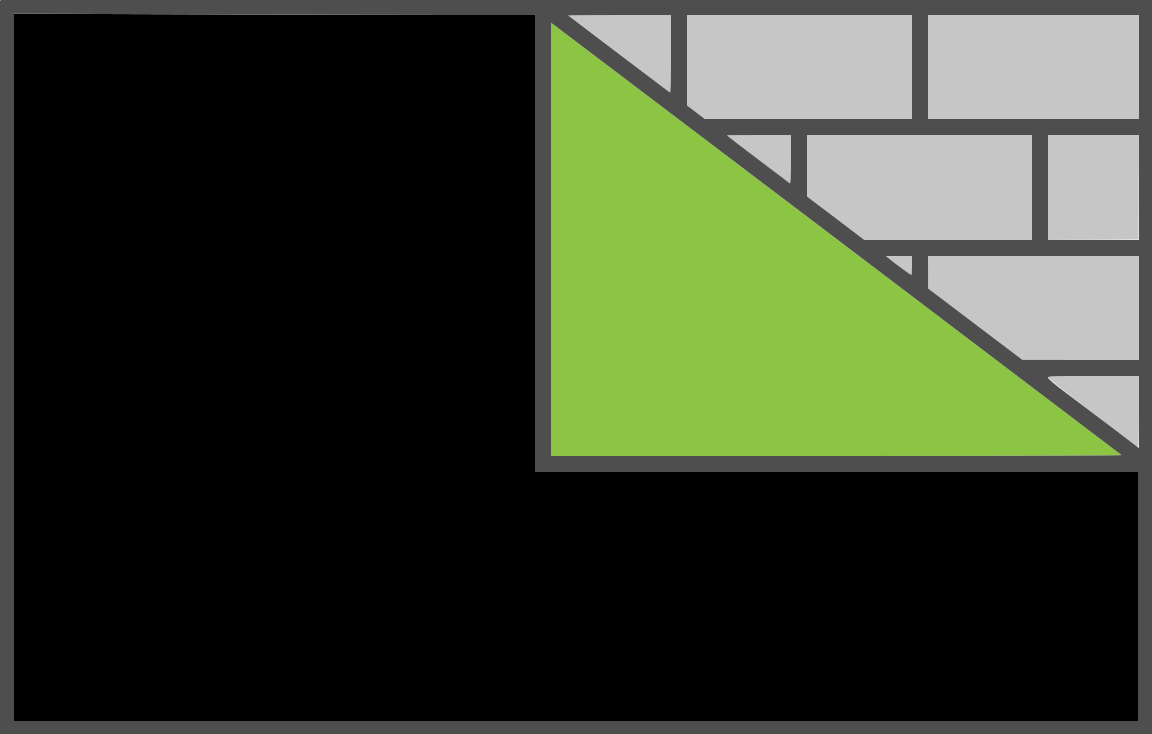
A modular thin brick and a full modular brick show the same face to the street, 2-1/4 by 7-5/8 in., so one unit of either covers the same area of wall. The PCI thin brick specification puts thickness at 1/2 in. to 1 in., and King Klinker fires its modular unit at 9/16 in. A full modular brick is 3-5/8 in. through the bed. Dividing one fired volume by the other is the whole argument.
| Unit | Thickness | Fired volume, cu in. | Full brick volume divided by this |
|---|---|---|---|
| Thin brick, thinnest in the PCI range | 1/2 in. | 8.58 | 7.25 |
| King Klinker modular | 9/16 in. | 9.65 | 6.44 |
| Thin brick, 5/8 in. | 5/8 in. | 10.72 | 5.80 |
| Full modular brick, for comparison | 3-5/8 in. | 62.19 | 1.00 |
So a thin brick uses between one seventh and one sixth of the fired clay a full brick uses to cover the same wall. Kiln energy and clay waste track the fired volume, which is the defensible form of the claim. Anything past that ratio belongs to the maker, and it takes an environmental product declaration to state it.
What King Klinker declares.
King Klinker's figures for King Klinker's product, per square metre.
| Declaration | Type III Environmental Product Declaration No. 296/2022, clinker brick slips. Program operator Instytut Techniki Budowlanej, Warsaw. Verified externally to ISO 14025. |
|---|---|
| Declared unit | 1 m2 of clinker brick slips, average weight 27.6 kg. |
| Scope | Modules A1 to A3, C1, C4 and D under EN 15804, cradle to gate with options. Data collected over calendar 2020. |
| Global warming potential, A1 to A3 | 18.1 kg CO2 eq. per m2, of which 15.1 kg is module A3, the manufacturing stage that includes firing. |
| Total non-renewable primary energy, A1 to A3 | 234 MJ per m2, of which 182 MJ is module A3. |
| Total renewable primary energy, A1 to A3 | 27.7 MJ per m2. |
| Declared service life | 100 years for the standard product. |
| End of life scenario | The declaration models the whole product recovered, half crushed for road foundation aggregate and half landfilled as mixed construction waste. |
| Validity | Issued 25 February 2022, valid to 25 February 2027. |
| Document | EPD 296/2022 (PDF) |
These figures describe the brick slip as it leaves the plant in Poland. They are not a figure for a finished precast panel, and they do not carry over to the other four makers. For an equivalent declaration from MetroBrick, Endicott, General Shale or Summitville, your Advanced rep will request it from the maker.
Freight is weight, and weight follows thickness.
A truck is filled by weight before it is filled by volume, so the square feet of wall that fit in one container track the fired volume by the same ratio as the table above. These are King Klinker's published weights against the 45,000 lb container.
| Format | Clay body | Lb per sq ft | Sq ft per 45,000 lb container |
|---|---|---|---|
| Modular | Brown or red | 5.20674 | 8,643 |
| Modular | White | 4.8445 | 9,289 |
| Norman | Brown or red | 5.1975 | 8,658 |
| Norman | White | 4.8015 | 9,372 |
The white clay body runs lighter per square foot than the brown or red body in every format. Weigh a real wall →
The facade and the wall arrive as one piece.
In precast the brick is cast into the structural panel, so a set of items a cavity wall needs never appears on the job.
| Veneer wythe | There is none. The brick is cast into the structural panel, so the facade and the wall are one piece. |
|---|---|
| Ties and anchors | Bond to the back of the brick is the whole connection. DN-25 notes the assembly can eliminate items a traditional masonry cladding needs, dovetail anchors among them. |
| Flashing and weep holes | DN-25 names both as items the assembly can eliminate, because the panel acts as a rain barrier rather than a drained cavity. |
| Scaffold and bricklaying on the elevation | The brick is set flat, at bench height, under a roof at the plant, and the finished panel is set with a crane. |
| Field trimming | The liner indexes the coursing and the joints, so the pattern resolves at the panel edge instead of being cut to fit in the bed. |
Assembly characteristics after PCI Designer's Notebook DN-25, Clay Product-Faced Precast Concrete. Panel design is the producer's; confirm against theirs.
Cuts happen in a plant.
Brick is set into the liner at the plant, flat and under cover, and any cutting happens there with plant dust control rather than on a scaffold. Starter and ender sheets close out the liner run so the pattern lands on the panel edge, which takes hand trimming out of the bed and stops the offcuts that trimming creates. Starter and ender sheets →
Service life is the largest lever.
A facade that is never replaced is the cheapest facade environmentally, and King Klinker's published results speak to that: at least 150 psi pull-out on all ten panels under ASTM C666 Procedure B, absorption under 5 percent to ASTM C1088, and no efflorescence. The full test table →
One tool, many pours.
Flex2Fit is a multi-use liner, so one tool runs again across pours instead of being consumed by a single panel. Reuse counts depend on the pattern and the job, and your Advanced rep confirms them. How Flex2Fit seals →
Where the brick is made.
Five makers, four of them in the United States.
| Maker | Where it is made |
|---|---|
| Endicott | Endicott, Nebraska |
| MetroBrick | Ironrock, Canton, Ohio |
| Summitville | Summitville, Ohio |
| General Shale | Johnson City, Tennessee, with the precast units cut at the Denver plant |
| King Klinker | Klinkier Przysucha S.A., Skrzyńsko, Poland |
Availability by color and format decides what a given job can actually use, so the shorter haul is worth asking about early rather than assuming it. Browse the colors →


Documenting a facade for a submittal
Tell your rep the maker and the format, and we send the test reports and any declaration the maker publishes.